The book at a glance
Four diagrams for the whole project: its argument, how it is made, its central thesis, and its evidence base.
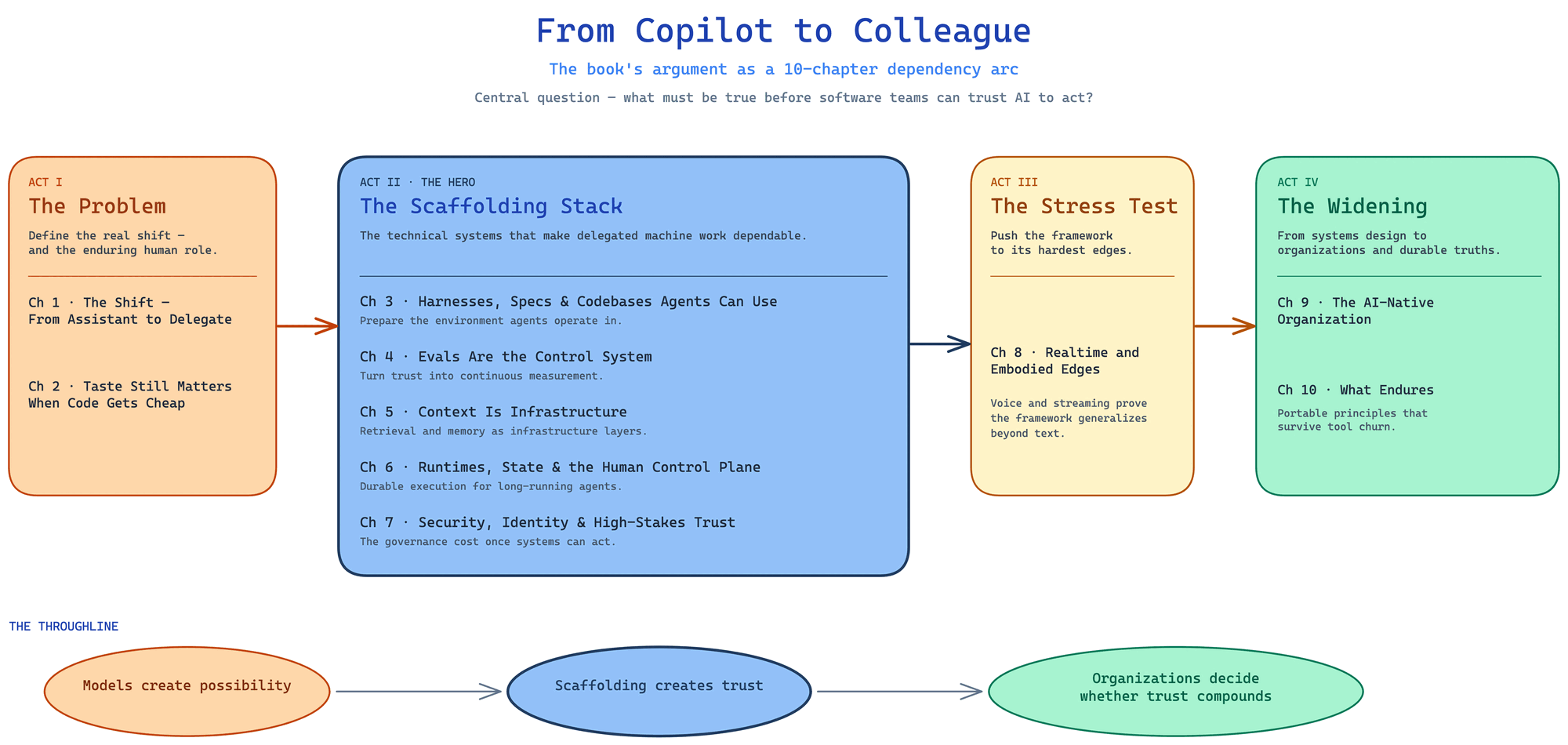
The Argument Spine
The ten chapters as a four-act dependency arc — the Problem (ch 1–2), the Scaffolding Stack (ch 3–7), the Stress Test (ch 8), and the Widening (ch 9–10). The book is an argument with a shape, not a survey, and it carries the throughline from possibility to compounding trust.
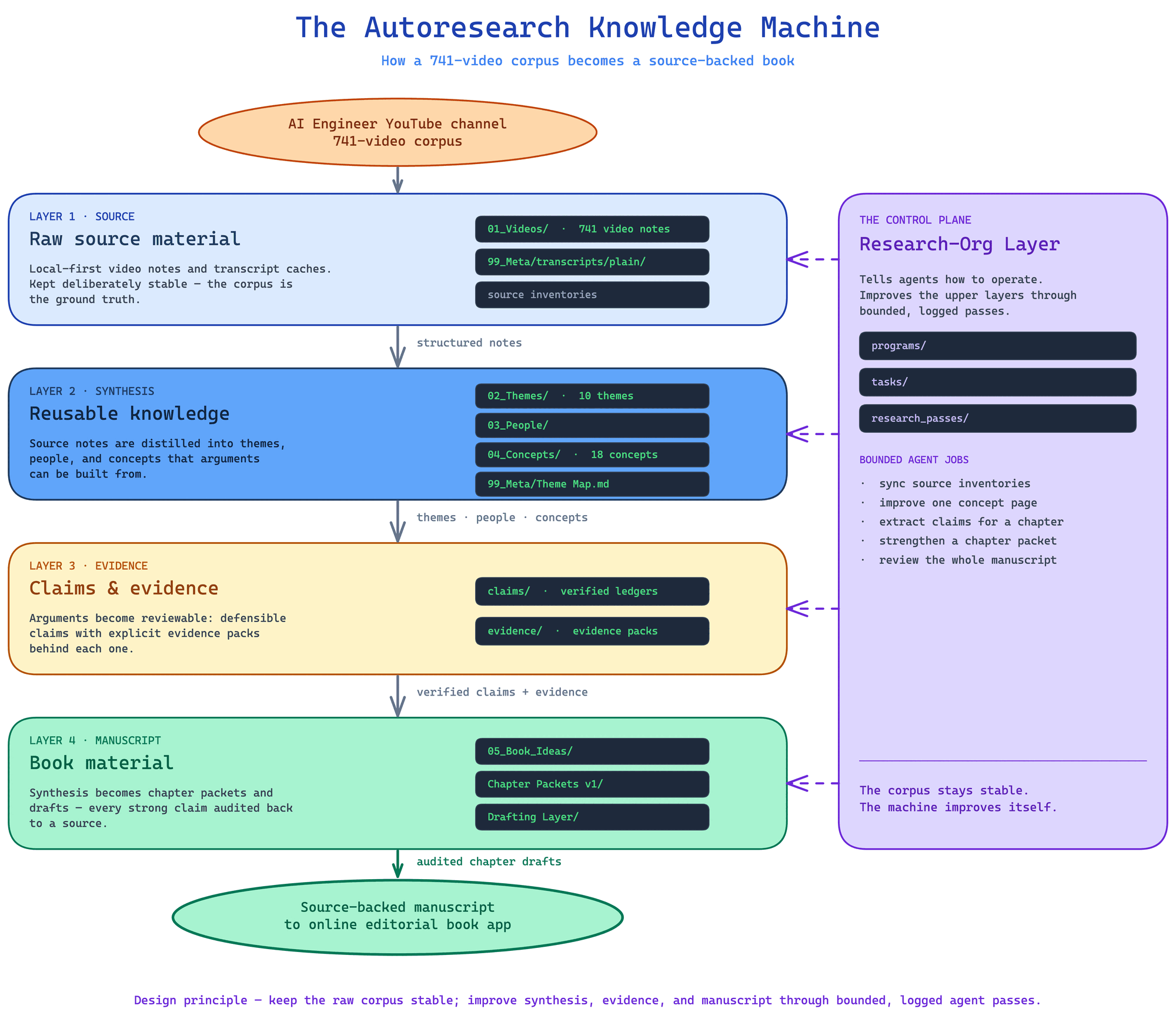
The Autoresearch Knowledge Machine
How a growing video corpus becomes a source-backed book: a five-layer pipeline — Source → Synthesis → Evidence → Manuscript — governed by a Research-Org control plane that improves the upper layers through bounded, logged agent passes. Live corpus size in STATS.md.
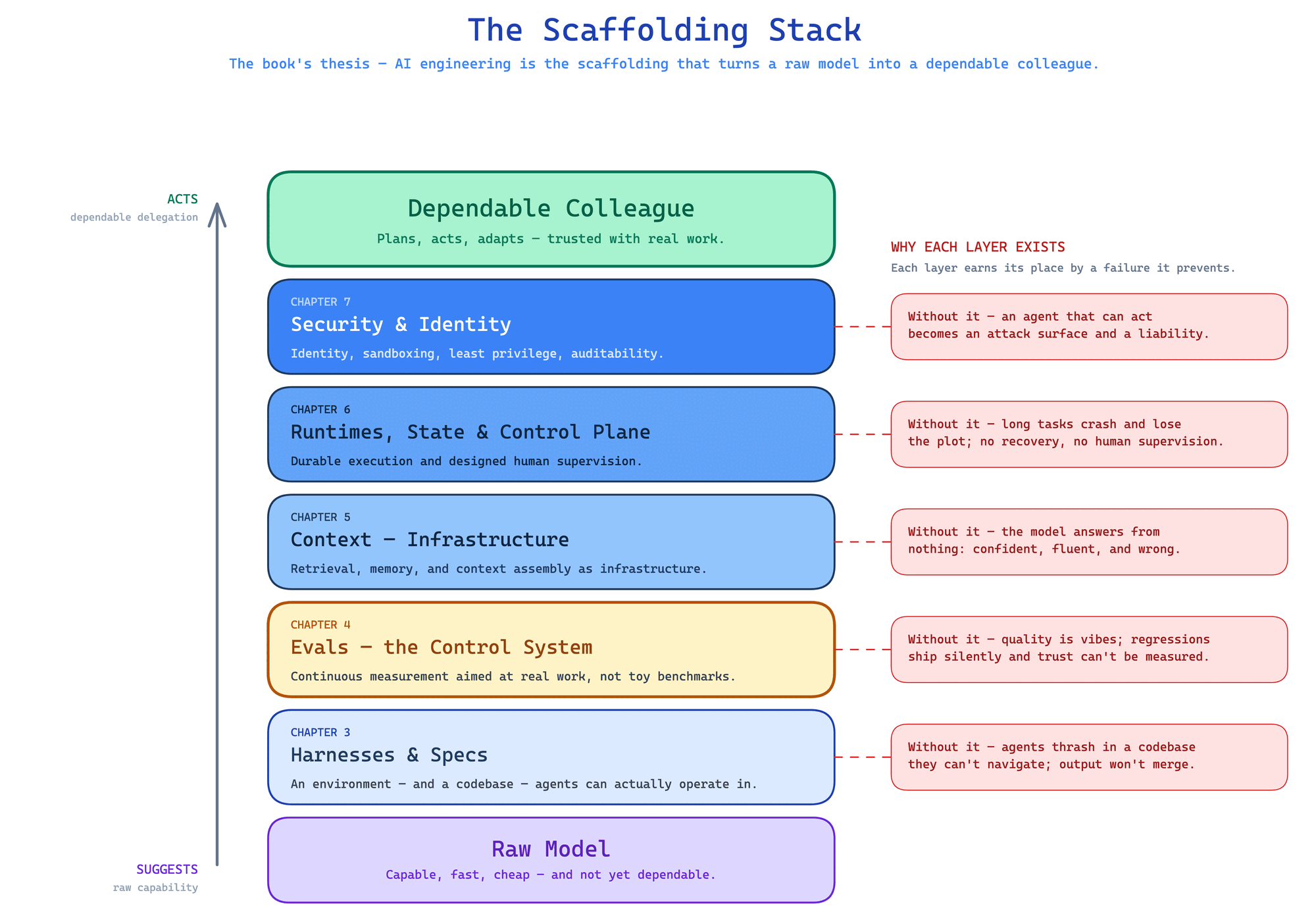
The Scaffolding Stack
The book's central thesis in one picture: a raw model is capable but not dependable. Five engineered layers wrap it — harnesses, evals, context, runtimes, security — and each one earns its place by a specific failure it prevents.
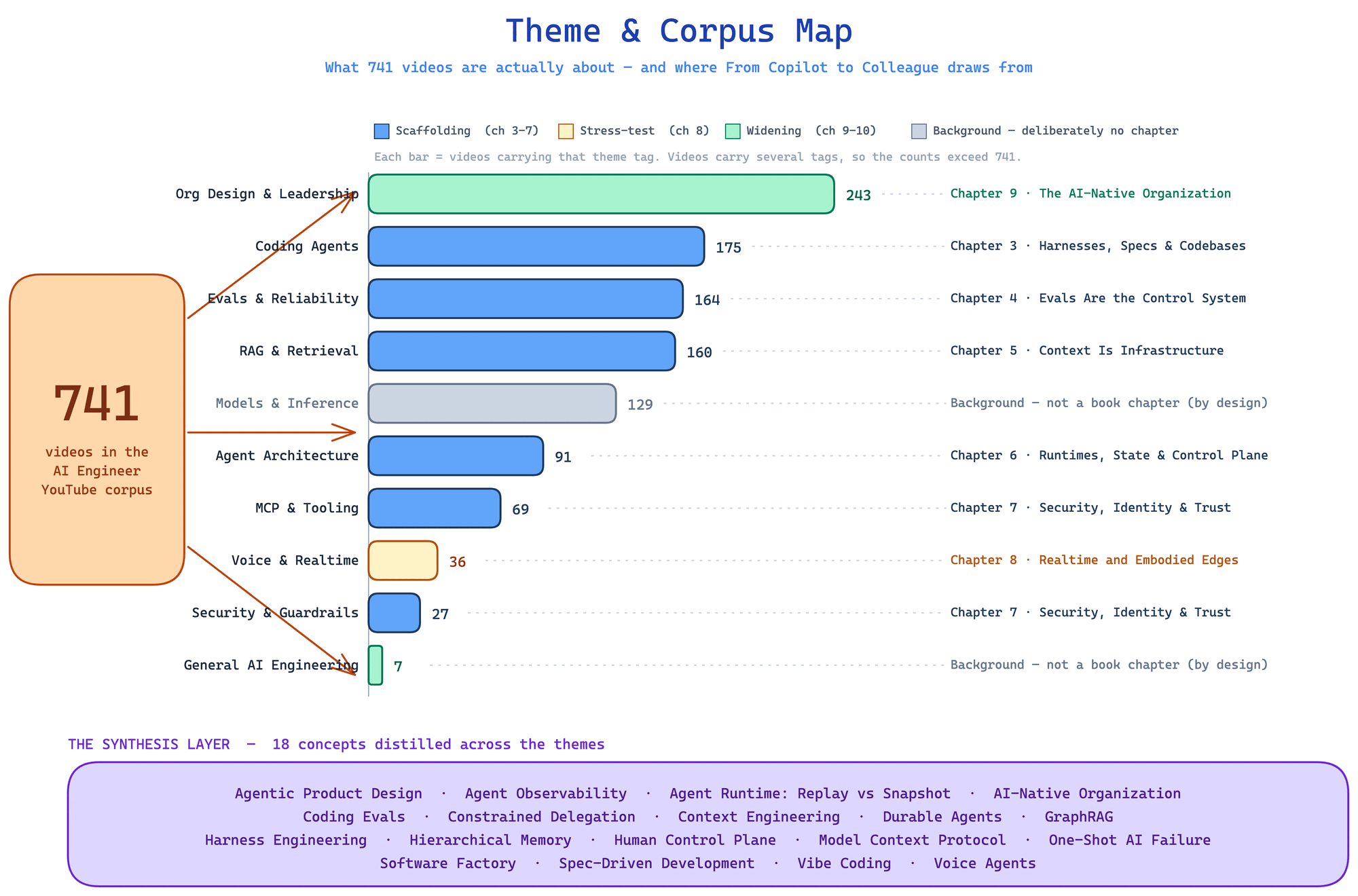
Theme & Corpus Map
What the corpus is actually about: ten themes sized by video count, colour-coded by the book act they feed, each mapped to its chapter — including the honest editorial call that Models & Inference is deliberately background, not a chapter.
The four acts
The ten chapters move through a four-act arc — the Problem, the Scaffolding Stack, the Stress Test, and the Widening. Each divider names the act, its chapters, and where it sits in the throughline.
Act I · The Problem
Chapters 1–2
Define the real shift — and the enduring human role.
Act II · The Scaffolding Stack
Chapters 3–7
The technical systems that make delegated machine work dependable.
Act III · The Stress Test
Chapter 8
Push the framework to its hardest edges.
Act IV · The Widening
Chapters 9–10
From systems design to organizations and durable truths.
How to read this book
Three maps. One picks a reading route by reader profile. One opens up The Method that produced the manuscript. One charts the dependency network of the eighteen concepts the book uses.
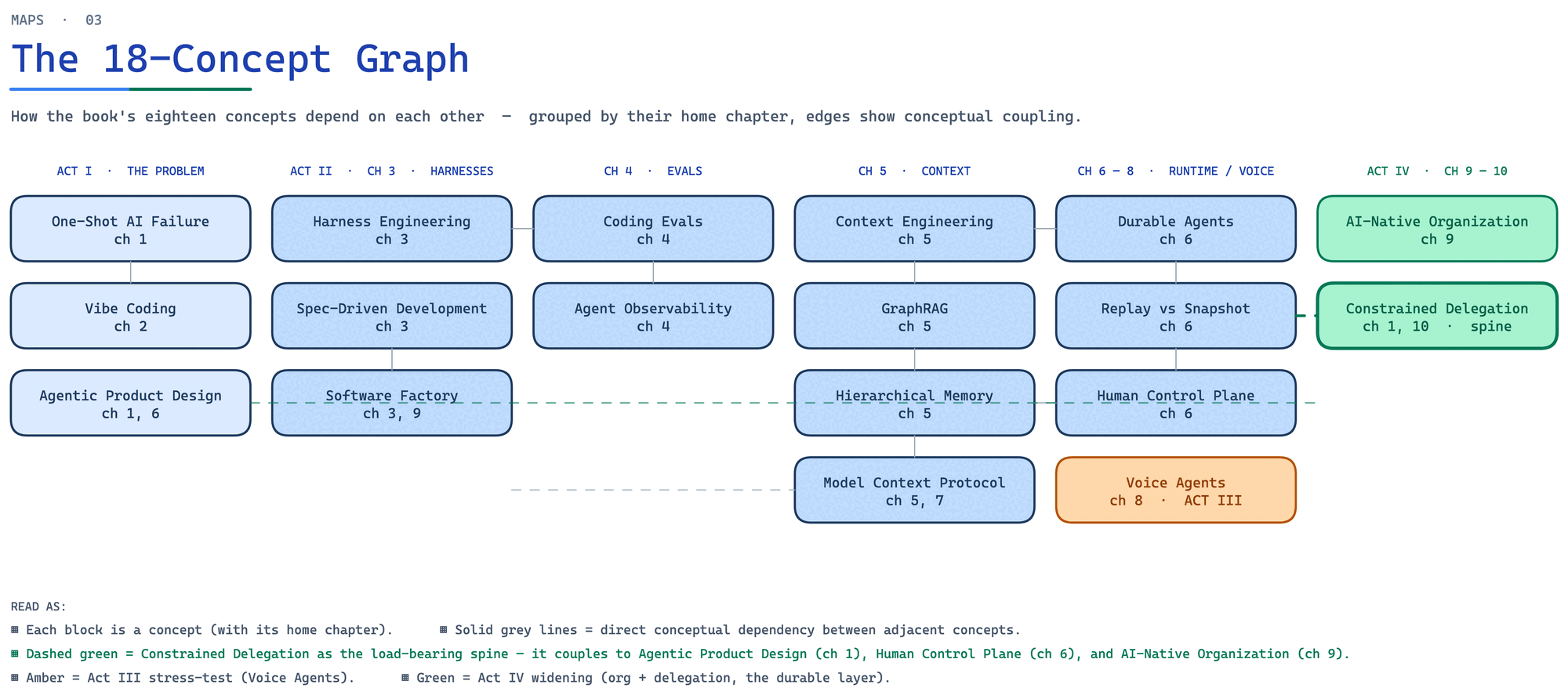
Concept Graph
Eighteen concepts from the manuscript drawn as a dependency network. Nodes are the named ideas — One-Shot AI Failure, Harness Engineering, Context Engineering, Durable Agents, Human Control Plane, and the rest. Edges are the dependencies and contrasts the book draws between them. Clusters mirror the four-act spine. A reader's map of the conceptual terrain.
Open full page →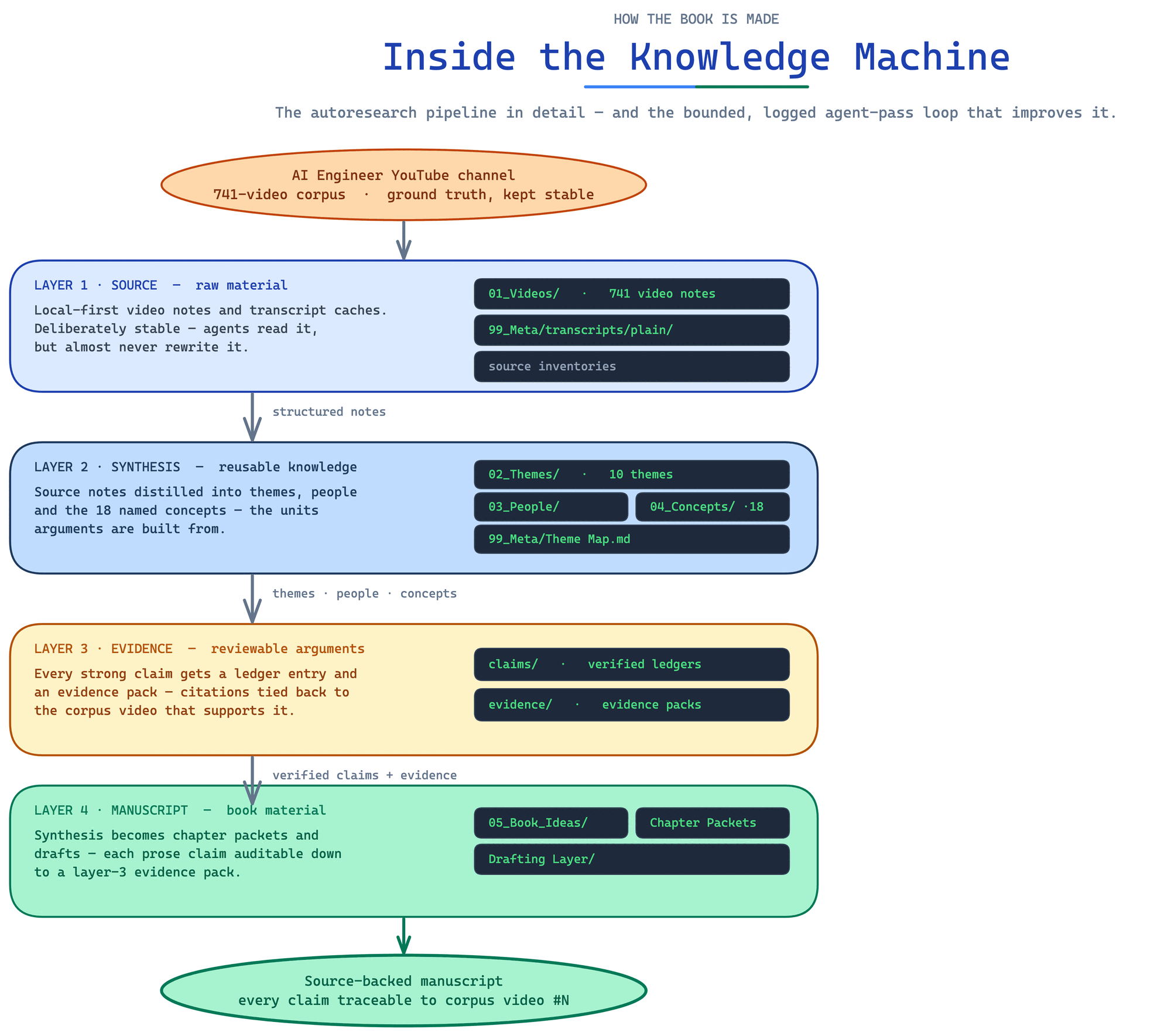
Methodology deep-dive
The autoresearch pipeline in detail. Five layers — Source (video notes), Synthesis (themes, people, eighteen concepts), Evidence (claims ledger plus evidence packs), Manuscript (chapter packets and drafts), and a Research-Org control plane that schedules bounded agent passes — pinned to the actual repo directories that hold them. The diagram surfaces what is usually invisible behind 'we used AI to write this.'
Open full page →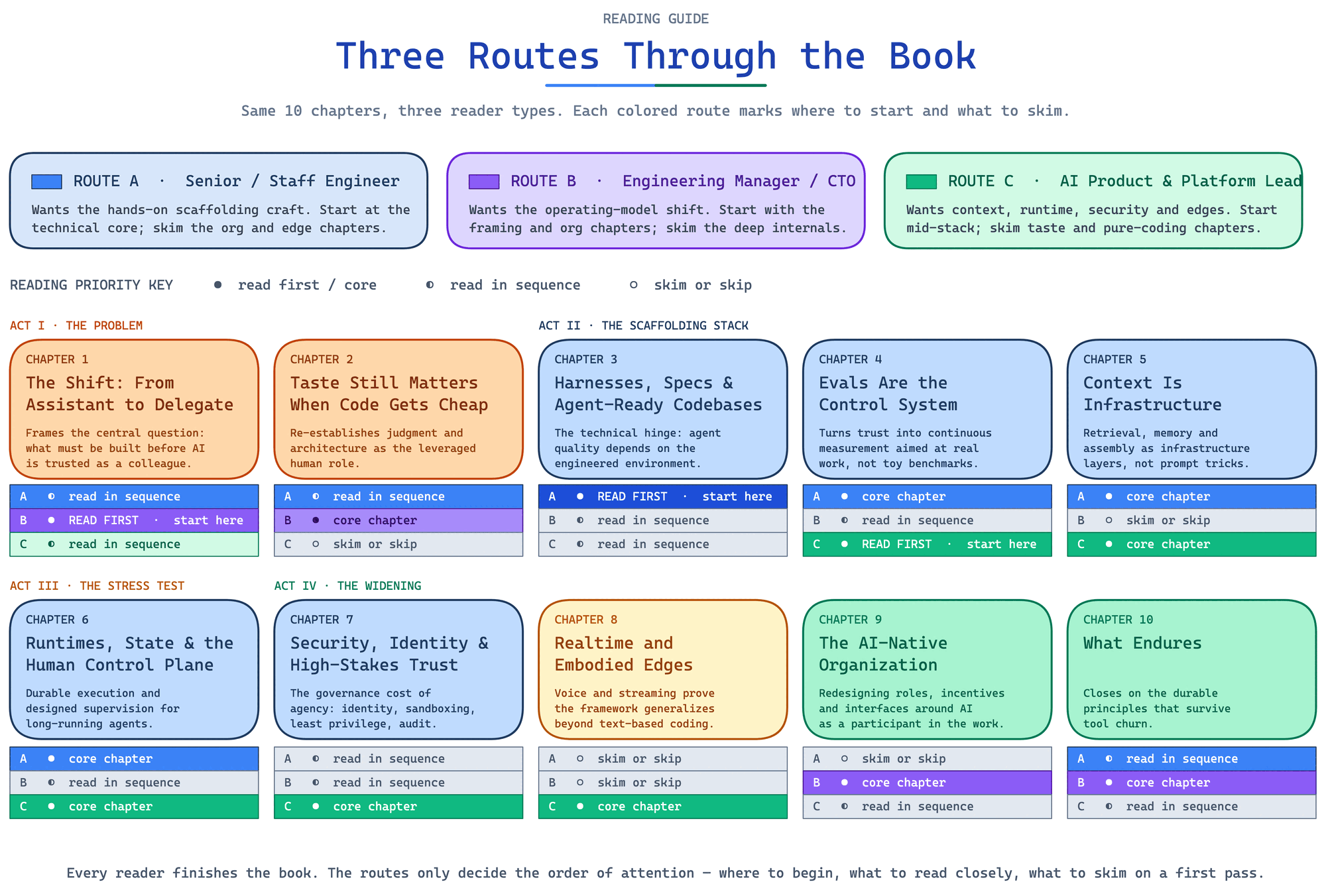
Reader's path
Three reading routes through the same ten chapters — for the senior or staff engineer, the engineering manager or CTO, and the AI product or platform lead. Each route marks which chapters to read first, which to read in sequence, and which to skim. Use this if you want the book without reading every chapter in order.
Open full page →Concepts
Eighteen named concepts that recur across the book — the units the arguments are built from. Click a card to enlarge, or open its full page.